
Everything you want to know about hyaluronic acid
December 6, 2023 – Marina Engervik

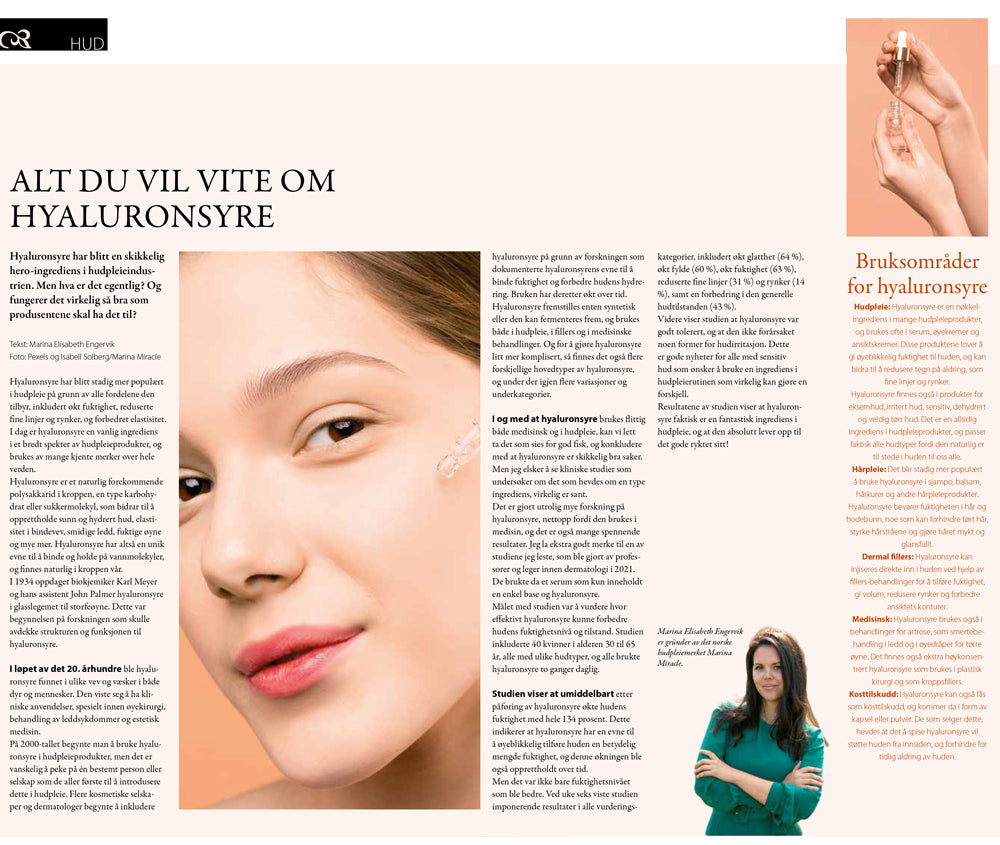
Our founder, Marina Engervik, regularly writes professional articles for the Norwegian industry magazine Kosmetikk. Here is an article she has written that covers everything you want to know about hyaluronic acid.
Hyaluronic acid has become a real hero ingredient in the skincare industry. But what exactly is hyaluronic acid? And does it really work as well as the manufacturers claim? Read on to learn more about the popular hyaluronic acid and whether it really lives up to its reputation!
But first; what is hyaluronic acid?
Hyaluronic acid is a naturally occurring polysaccharide in the body, a type of carbohydrate, that helps maintain healthy and hydrated skin, elasticity in connective tissue, supple joints, moist eyes and much more. Hyaluronic acid has a unique ability to bind and retain water molecules and is found naturally in our bodies.
The story behind hyaluronic acid
In 1934, biochemist Karl Meyer and his assistant John Palmer discovered hyaluronic acid in the vitreous humor of cattle eyes. This was the beginning of research that would uncover the structure and function of hyaluronic acid. During the 20th century, hyaluronic acid was found in various tissues and fluids in both animals and humans. It turned out to have clinical applications, especially in eye surgery, the treatment of joint diseases and aesthetic medicine. Medical studies have also discovered the role of hyaluronic acid in everything from fertilization and the formation of the embryo to wound healing, aging processes and our immune system. The discovery of hyaluronic acid has had a major impact on medicine and science.
The use of hyaluronic acid in skincare products began in the 2000s, but it is impossible to point to one specific person or company as the very first to use it in skincare. Several cosmetic companies and dermatologists began including hyaluronic acid in skincare products due to this research that documented hyaluronic acid's ability to bind moisture and improve skin hydration.
How is hyaluronic acid used?
Hyaluronic acid has become increasingly popular in skincare due to the many benefits it offers, including increased hydration, reduced fine lines and wrinkles, and improved skin elasticity. Today, hyaluronic acid is a common ingredient in a wide range of skincare products and is used by many well-known brands worldwide.
As the use of hyaluronic acid in skincare has grown over time, it is difficult to attribute this development to a single inventor or company. It has been the result of research, innovation, and a growing understanding of the benefits this ingredient has for the skin.
Hyaluronic acid is used in both skin care, fillers and medical treatments. Hyaluronic acid is either produced synthetically or it can be fermented. And to make hyaluronic acid a little more complicated, there are also several different main types of hyaluronic acid and under that again several variations and subcategories of hyaluronic acid.
Skin care: Hyaluronic acid is a key ingredient in many skin care products, and is often used in serums, eye creams, and face creams. These products claim to provide instant hydration to the skin and can help reduce signs of aging, such as fine lines and wrinkles. Hyaluronic acid is also found in products for eczema, irritated skin, sensitive, dehydrated, and very dry skin.
Hyaluronic acid is a versatile ingredient in skincare products and actually suits all skin types because hyaluronic acid is naturally present in the skin of all of us.
Hair care: The use of hyaluronic acid in shampoos, conditioners, hair treatments and other hair care products is becoming increasingly popular. Hyaluronic acid retains moisture in the hair and scalp, which can prevent dry hair, strengthen hair strands and make hair soft and shiny.
Dermal Fillers: Hyaluronic acid can be injected directly into the skin using filler treatments to add moisture, volume, reduce wrinkles and improve facial contours.
Medical: Hyaluronic acid is also used in treatments for osteoarthritis, as a pain reliever for joints, and in eye drops for dry eyes. There is also extra-highly concentrated hyaluronic acid that is used in plastic surgery and body fillers.
Dietary supplements: Hyaluronic acid is also available as a dietary supplement. It comes in capsule or powder form, and those who sell it claim that consuming hyaluronic acid will support the skin from the inside and prevent premature aging of the skin.
5 Different Main Types of Hyaluronic Acid
- Low molecular weight hyaluronic acid: This type has a smaller molecular weight and is quickly absorbed into the skin. It is used in skin care products that claim to penetrate deeper to provide moisture and reduce fine lines. It is also used medically, such as in wound care and eye drops.
- High molecular weight hyaluronic acid: With a higher molecular weight, this helps form a protective barrier on the skin's surface. It is used in skincare products to provide long-lasting moisture and improve skin elasticity.
- Ultra-low molecular weight hyaluronic acid: With an even smaller molecular weight than low molecular weight hyaluronic acid, this is quickly absorbed into the skin. It is used in skincare products that penetrate deep into the skin to repair wounds and damaged tissue and provide deep hydration.
- Reticular hyaluronic acid: Has a linear or branched structure between hyaluronic acid molecules. This type of hyaluronic acid is often used in dermal fillers to add volume and smooth wrinkles and fine lines.
- Cross-linked hyaluronic acid: Cross-linked hyaluronic acid is modified to contain cross-links between the hyaluronic acid molecules, creating a more intertwined and gel-like structure. It is often used in fillers to shape facial contours and provides long-lasting results. It is also used as a medical treatment for osteoarthritis to relieve pain and improve joint function.
And finally; is hyaluronic acid really that good?
We have seen that hyaluronic acid is widely used both medically and in skincare, and we can easily take this for granted and conclude that hyaluronic acid is really good stuff. But I love seeing clinical studies that prove whether what is claimed about a type of ingredient is really true. An incredible amount of research has been done on hyaluronic acid, precisely because it is used in medicine, and there are also many exciting results. One of the studies I read, which was done by professors and doctors in dermatology in 2021, I particularly noticed. In this study, they had a serum that only contained a simple base and hyaluronic acid.
The research objective of the study was to assess how effectively hyaluronic acid could improve skin moisture levels and condition. The study included 40 women aged 30-65, all with different skin types. All used hyaluronic acid twice daily.
The study shows that immediately after applying hyaluronic acid, skin moisture increased by a whopping 134%. This indicates hyaluronic acid's ability to instantly deliver a significant amount of moisture to the skin. This increase in skin moisture was also maintained over time, with an increase of 55% after 6 weeks.
But it wasn’t just moisture levels that improved. By week 6, the study showed impressive results across all assessment categories, including increased smoothness (64%), plumpness (60%), moisture (63%), reduced fine lines (31%) and wrinkles (14%), as well as an improvement in overall skin condition (43%).
Furthermore, the study shows that hyaluronic acid was well tolerated and did not cause any skin irritation. This is good news for all of us with sensitive skin who want to use an ingredient in our skincare routine that can really make a difference.
The results of the study prove that hyaluronic acid is indeed a fantastic ingredient in skincare and that hyaluronic acid certainly lives up to its good reputation!
Marina Miracle products containing hyaluronic acid
We use hyaluronic acid in our products that are designed to provide extra moisture to the skin. In these products we use both high molecular and low molecular hyaluronic acids. You get hyaluronic acid in these Marina Miracle products:
- Super Skin Food Mask - Moisturizing facial mask
- S.ave O.ur S.kin - SOS Balm for dry winter skin and eczema
- Flower Berry Essence - Hydrating essence for all skin types
- Amaranth Day & Night Cream - Rich and moisturizing anti-ageing cream
- PRO Green Mask - Special mask, only available in salon treatment


