
Myths and facts about probiotics
June 12, 2020 – Marina Engervik

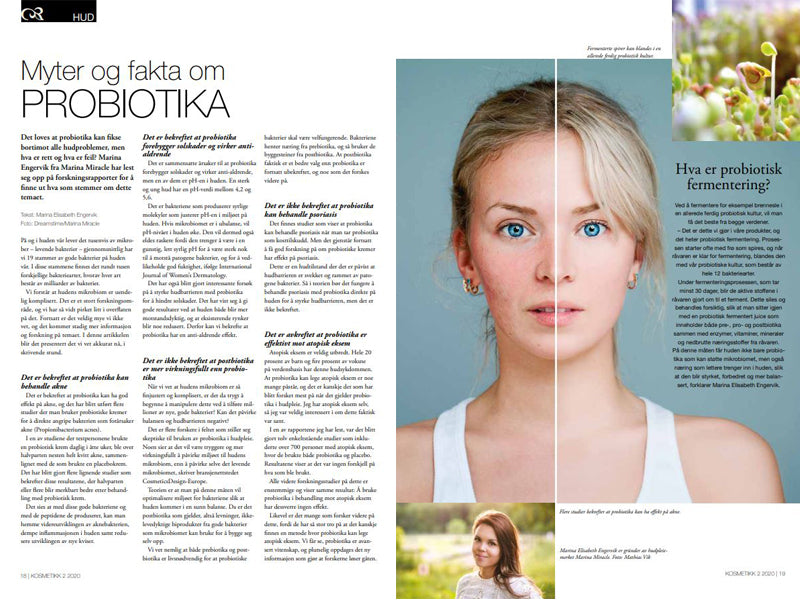
Did you know that our founder, Marina Engervik, is a columnist and writes professional articles for the industry magazine Kosmetikk? They recently published an article about probiotics that Marina wrote. You can read the full article here:
Myths and facts about probiotics
It is promised that probiotics can fix almost all skin problems, but what is right and what is wrong? Marina Engervik from Marina Miracle has read up on research reports to find out what is true about this.
the theme.
Text: Marina Elisabeth Engervik
Photo: Dreamstime/Marina Miracle
Thousands of microbes – living bacteria – live on and in our skin – on average we have 19 strains of good bacteria on our skin. Within these strains are around a thousand different bacterial species, each of which
consists of billions of bacteria. We understand that the skin microbiome is infinitely complex. It is a vast area of research, and we have only scratched the surface of it. There is still a great deal we do not know, and more information and research is constantly emerging on the topic. This article presents what we know right now, at the time of writing.
It has been confirmed that probiotics can treat acne
It has been confirmed that probiotics can have a good effect on acne, and several studies have been conducted using probiotic creams to directly attack the bacteria that causes acne (Propionibacterium acnes). In one of the studies where test subjects used a probiotic cream daily for eight weeks, more than half of them almost completely got rid of their acne, compared to those who used a placebo cream. Several similar studies have been conducted that confirm these results, with half or more of them noticeably improving after treatment with probiotic cream.
It is said that with these good bacteria and the peptides they produce, you can inhibit the further development of acne bacteria, reduce inflammation in the skin and reduce the development of new pimples.
Probiotics have been confirmed to prevent sun damage and have anti-aging effects.
There are complex reasons why probiotics prevent sun damage and have anti-aging effects, but one of them is the pH of the skin. Strong and young skin has a pH value between 4.2 and 5.6. It is the bacteria that produce acidic molecules that adjust the pH of the skin's environment. If the microbiome is unbalanced, the pH level in the skin will increase. It will therefore also age faster because it needs to be in a favorable, slightly acidic pH to be strong enough to resist pathogenic bacteria, and to maintain good moisture, according to the International Journal of Women's Dermatology. Interesting attempts have also been made to strengthen the skin barrier with probiotics to prevent sun damage. It has been shown to give good results in that the skin both becomes more resistant and that existing wrinkles are somewhat reduced. Therefore, we can confirm that probiotics have an anti-aging effect.
It has not been confirmed that postbiotics are more effective than probiotics.
When we know that the skin microbiome is so finely tuned and complicated, is it safe to start manipulating this by adding millions of new, good bacteria? Could it negatively affect the balance and the skin barrier? There are several researchers in the field who are skeptical about the use of probiotics in skin care. Some say that it will be safer and more effective to influence the environment of the skin microbiome than to influence the living microbiome itself, writes the industry website CosmeticsDesign-Europe. The theory is that in this way you will optimize the environment for the bacteria so that the skin comes into a healthy balance. Then it is postbiotics that apply, that is, leftovers, non-viable by-products from good bacteria that the microbiome can use to build itself up. We know that both prebiotics and postbiotics are essential for probiotic bacteria to function properly. The bacteria obtain nutrition from prebiotics, and then they use building blocks from postbiotics. Whether postbiotics are actually a better choice than probiotics is still unconfirmed, and something that is being further researched.
It is not confirmed that probiotics can treat psoriasis.
There are studies that show that probiotics can treat psoriasis when taken as a dietary supplement. However, there is still a lack of good research on whether probiotic creams are effective in psoriasis. This is a skin condition where it has been shown that the skin barrier is weakened and affected by pathogenic bacteria. So in theory, treating psoriasis with probiotics directly on the skin to strengthen the skin barrier should work, but this has not been confirmed.
Probiotics have been shown to be effective in treating atopic dermatitis.
Atopic eczema is very common. A full 20 percent of children and four percent of adults worldwide have this skin disease. That probiotics can cure atopic eczema is something that many claim, and it is perhaps what has been researched the most when it comes to probiotics in skin care. I have atopic eczema myself, so I was very interested in whether this was actually true. In one of the reports I have read, twelve separate studies had been conducted that included over 700 people with atopic eczema, where they used both probiotics and placebo. The results show that there was no difference between what was used. All further research studies on this are unanimous and show the same result: Using probiotics in the treatment of atopic eczema unfortunately has no effect. Nevertheless, many people are researching this further, because they have such great faith that there may be a method where probiotics can cure atopic eczema. We will see, probiotics are advanced science, and suddenly new information is discovered that allows scientists to solve the puzzle.
What is probiotic fermentation?
By fermenting, for example, nettle in an already prepared probiotic culture, you will get the best of both worlds.
– This is what we do in our products, and it is called probiotic fermentation. The process often starts with seeds that are germinated, and when the raw material is ready for fermentation, it is mixed with our probiotic culture, which consists of 12 species of bacteria. During the fermentation process, which takes at least 30 days, the active substances in the raw material are converted into a ferment. This is strained and carefully processed, so that you are left with a probiotic fermented juice that contains both pre-, pro- and postbiotics along with enzymes, vitamins, minerals and broken down nutrients from the raw material. In this way, the skin not only receives probiotics that can support the microbiome, but also nutrition that penetrates the skin more easily, so that it is strengthened, improved and more balanced, explains Marina Elisabeth Engervik.


